

Abacus Classes vs Vedic Maths: Understanding the Differences
Introduction
Parents today are increasingly looking for ways to improve their children’s mathematical abilities beyond traditional classroom learning. Two of the most popular methods are abacus classes and Vedic Maths. While both aim to enhance calculation skills and boost confidence in mathematics, they differ significantly in their approach, learning process, and benefits.
If you’re wondering which method is better suited for your child, understanding the differences can help you make an informed decision. In this article, we’ll explore how abacus classes and Vedic Maths work, their unique advantages, and why many parents choose to start with abacus training during their child’s early learning years.
What Are Abacus Classes?
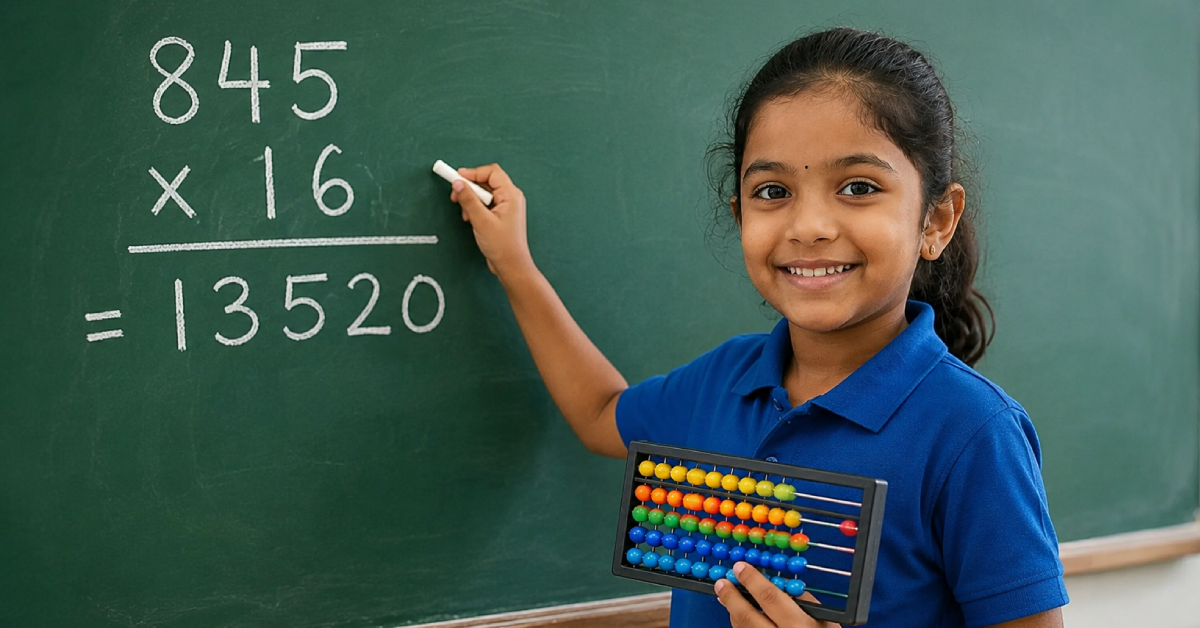
Abacus classes teach children to perform arithmetic calculations using an abacus, a traditional counting tool consisting of beads arranged on rods. Students first learn to move the beads physically to solve mathematical problems. Over time, they develop the ability to visualize the abacus mentally and perform calculations without using the actual instrument.
This mental visualization technique helps children solve addition, subtraction, multiplication, and division problems quickly and accurately.
Key Features of Abacus Classes
- Uses a physical abacus as a learning tool.
- Develops mental calculation skills through visualization.
- Improves concentration and memory.
- Enhances both left and right brain development.
- Suitable for young children, typically between 5 and 14 years.
At Velsai Abacus, students can learn through both online and offline abacus classes, making it convenient for families with different schedules and learning preferences.
What Is Vedic Maths?
Vedic Maths is a system of mathematical techniques derived from ancient Indian mathematical principles. It uses various formulas, shortcuts, and mental strategies to simplify calculations and solve problems faster.
Rather than relying on visualization tools, Vedic Maths focuses on understanding patterns and applying specific methods to perform arithmetic operations efficiently.
Key Features of Vedic Maths
- Uses mathematical shortcuts and formulas.
- Speeds up calculations.
- Simplifies complex arithmetic problems.
- Helps students prepare for competitive exams.
- Suitable for older children and teenagers who already understand basic arithmetic concepts.
Major Differences Between Abacus Classes and Vedic Maths
1. Learning Method
Abacus Classes
- Start with a physical abacus.
- Gradually develop mental visualization skills.
- Focus on strengthening cognitive abilities.
Vedic Maths
- Uses formulas and shortcuts.
- Focuses on applying techniques to solve problems quickly.
- Relies on mathematical understanding and pattern recognition.
2. Ideal Age Group
Abacus Classes
- Best suited for children aged 5 to 14 years.
- Particularly effective during the brain’s developmental years.
Vedic Maths
- Usually introduced to children aged 10 years and above.
- More beneficial once basic arithmetic concepts are well established.
3. Brain Development Benefits
One of the biggest advantages of abacus classes is their impact on overall cognitive development.
Children who regularly practice abacus techniques often show improvements in:
- Concentration
- Memory retention
- Visualization skills
- Listening ability
- Confidence
- Problem-solving skills
Vedic Maths primarily focuses on improving calculation speed and mathematical efficiency rather than broader cognitive development.
4. Calculation Approach
Abacus Classes
- Build strong mental imagery.
- Encourage visual and auditory learning.
- Improve calculation accuracy.
Vedic Maths
- Uses mathematical tricks and formulas.
- Reduces the number of steps needed to solve problems.
- Improves speed during examinations.
5. Long-Term Skill Development
While Vedic Maths provides valuable shortcuts for solving problems quickly, abacus classes lay a strong foundation for lifelong mental calculation abilities and cognitive growth.
Many educators recommend learning abacus first and then progressing to Vedic Maths later, allowing children to benefit from both systems.
Which Is Better for Your Child?
The answer depends on your child’s age and learning goals.
Choose Abacus Classes If:
- Your child is between 5 and 14 years old.
- You want to improve concentration and memory.
- You want to strengthen overall brain development.
- Your child is beginning their mathematical learning journey.
- You want them to develop strong mental arithmetic skills.
Choose Vedic Maths If:
- Your child already has a good understanding of basic mathematics.
- They need faster calculation techniques for exams.
- They enjoy learning mathematical patterns and shortcuts.
- They are preparing for competitive tests.
Can Children Learn Both?
Absolutely.
In fact, many students benefit from learning both methods at different stages of their educational journey.
A common progression is:
- Start with abacus classes during the early years.
- Build strong mental calculation and concentration skills.
- Learn Vedic Maths later to gain advanced calculation shortcuts.
This combination provides both cognitive development and mathematical efficiency.
Why Parents Choose Velsai Abacus
At Velsai Abacus, we focus on helping children develop strong mathematical and cognitive skills through structured abacus classes. Our programs are designed to make learning engaging, enjoyable, and effective.
What We Offer
- Expert abacus trainers
- Interactive learning environment
- Online abacus classes for flexible learning
- Offline classroom training for personalized guidance
- Progressive curriculum suitable for different age groups
- Regular assessments and performance tracking
Our goal is not just to improve calculation speed but also to enhance concentration, memory, confidence, and overall academic performance.
Conclusion
Both abacus and Vedic Maths are valuable learning systems, but they serve different purposes. While Vedic Maths focuses on mathematical shortcuts and speed, abacus classes help children develop mental arithmetic skills while strengthening important cognitive abilities such as memory, concentration, and visualization.
For younger learners, abacus classes often provide a stronger foundation that supports long-term academic success. As children grow older, they can complement these skills with Vedic Maths techniques for even greater mathematical proficiency.
If you’re looking for a comprehensive learning experience that supports both academic and cognitive development, Velsai Abacus offers professional online and offline abacus classes designed to help every child reach their full potential.